
Looking back, one of the biggest lessons I learned from 2020 wasn’t about shortages. It was about timing—and how wise stewardship often begins long before we realize we’ll need it.
A few weeks ago, I found myself standing in the pantry trying to figure out where to put yet another container of cornstarch.
The problem wasn’t that we needed more cornstarch.
The problem was that my husband and I had both noticed a sale, both independently decided it would be wise to stock up, and neither of us thought to mention it to the other.
By the time we realized what had happened, we had accumulated enough cornstarch to last us quite a while. In fact, we ended up sharing some with our children because there was simply more than we could reasonably use ourselves.
We laughed about it, but the experience reminded me of something important. One of the greatest lessons I have learned over the past few years is that preparation begins with awareness. Before buying more, it is wise to know what you already have.
That may seem like a simple lesson, but it stems from how my thinking has changed about shopping, stewardship, and preparation.
🌿 The Lesson Empty Shelves Taught Me
Like many people, I remember walking into grocery stores in 2020 and seeing partially empty shelves. At the time, what concerned me most was not necessarily what was missing. It was the realization that thousands of people were all trying to solve the same problem at the same time.
Everyone suddenly needed the same things. Everyone was shopping from a position of urgency. Everyone was reacting rather than planning. Looking back, I can see that the greatest lesson was not about shortages. It was about timing.
When we wait until we desperately need something, our options become limited. We often pay more, settle for less, or make decisions we would not normally make. Fear has a way of narrowing our focus and convincing us that immediate action is always the best action.
Scripture repeatedly points us toward a different approach. Proverbs 21:5 tells us, “The thoughts of the diligent tend only to plenteousness; but of every one that is hasty only to want.” Diligence requires foresight. It requires paying attention. It requires making decisions before circumstances force our hand.
Over time, I have come to realize that wise preparation is not about stockpiling. It is about reducing the likelihood that fear will influence my decisions.
🌿 Learning to Buy from a Position of Peace
One way this has changed my life is through the way I shop.
I still pay attention to sales. I still purchase items ahead of time when it makes sense. However, I am also intentional about what I buy. For our family, preparation is not simply about having food on the shelf. It is about having food that aligns with our values and supports our health.
Whenever possible, I focus on whole foods and minimally processed ingredients. I also prefer organic options when they fit within our budget and priorities. Because of that, I rarely complete all of my shopping in one location.
Some items come from Kroger. Others come from Food Lion or Walmart. Certain staples are purchased through Azure Standard. We also enjoy visiting local farmers markets and roadside stands throughout the growing season.
Over time, I have learned that different stores often excel in different areas. One may have the best price on a particular item, while another carries a product I cannot find elsewhere. Wise stewardship involves paying attention, comparing prices, and resisting the temptation to assume that convenience is always the best value.
Stewardship is not measured by how much we accumulate but by how well we manage what God has entrusted to us.
The older I get, the more I realize that peace is a gift that protects us from poor decisions. When fear takes control, it becomes difficult to think clearly. We tend to react rather than reflect, consume rather than consider, and rush rather than pray.
Paul reminds believers in Philippians 4:6-7 not to be anxious, but instead to bring their concerns before God in prayer. The result is not necessarily immediate answers, but peace—a peace that guards both our hearts and our minds. I have found that some of the wisest purchasing decisions I have made were not made from urgency, but from a place of peace.
“Be careful for nothing; but in every thing by prayer and supplication with thanksgiving let your requests be made known unto God. And the peace of God, which passeth all understanding, shall keep your hearts and minds through Christ Jesus.” Philippians 4:6-7 (KJV)
🌿 Learning What Is Worth Growing
Another lesson I have learned is that stewardship is not about doing everything yourself.
When people first become interested in gardening, there is often a temptation to grow everything possible. I understand that feeling because I have experienced it myself.
Over time, however, I have learned to evaluate gardening through a different lens. The question is not simply, “Can I grow it?” The better question is, “Should I grow it?”
Garden space, time, energy, and resources are all limited. Stewardship requires using those resources wisely.
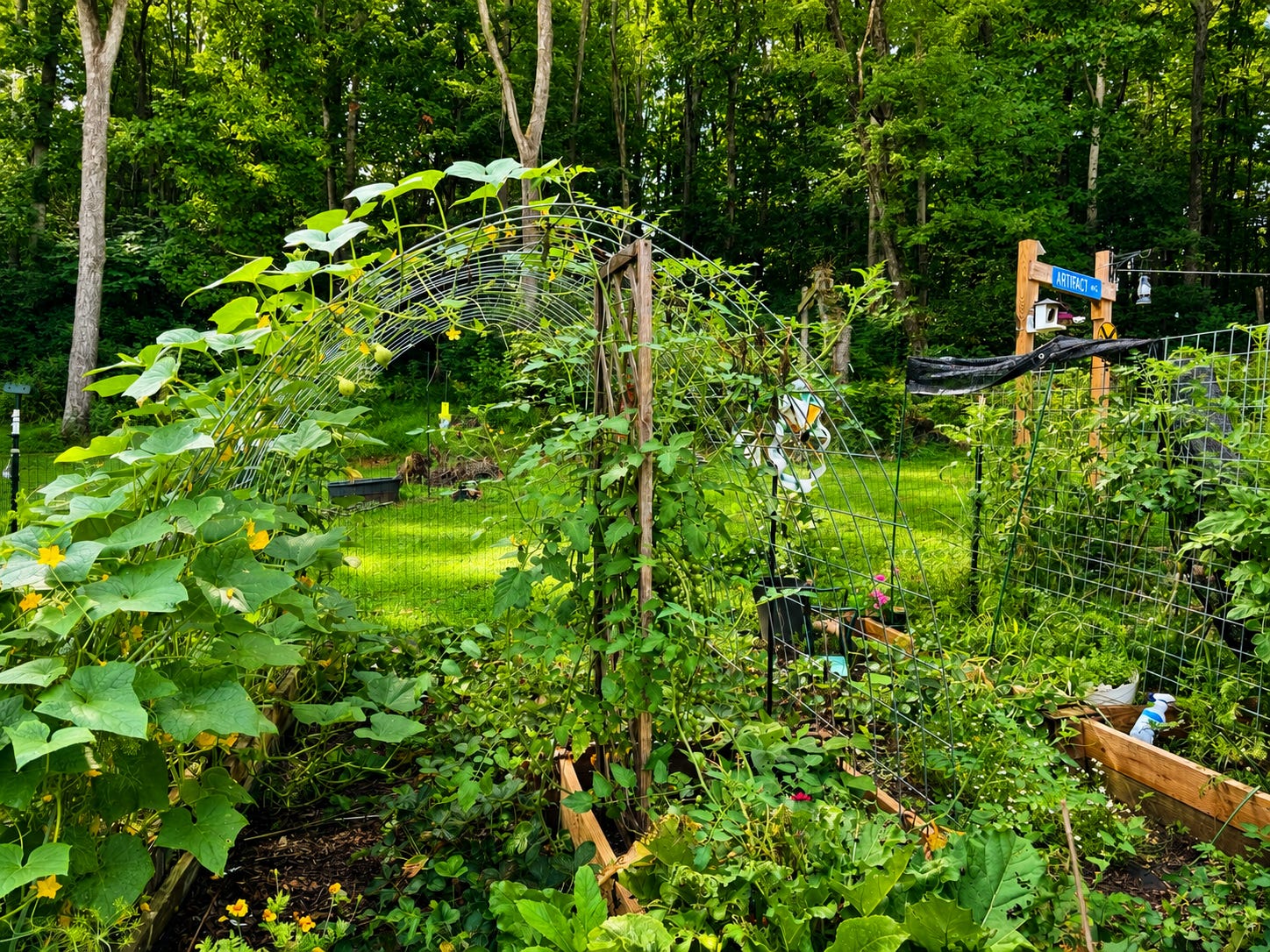
Tomatoes are a perfect example. We grow some tomatoes every year, but tomatoes require a significant amount of space and attention. Because I enjoy canning tomato products, I often purchase additional bushels from a local Mennonite farmers stand when tomatoes are at their seasonal peak.
Some people may see that as a shortcut. I see it as stewardship.
Those tomatoes eventually become ketchup, barbecue sauce, pasta sauce, pizza sauce, regular tomato sauce, and, if all goes well, taco sauce this year. Purchasing locally grown tomatoes allows me to support a local farmer while making efficient use of the resources God has given me.
The same philosophy extends beyond the garden. We purchase our beef from local farmers rather than raising cattle ourselves. While I appreciate the idea of complete self-sufficiency, I have come to believe that stewardship often involves recognizing what others can do well and supporting them in the process.
Local farmers possess knowledge, equipment, land, and experience that we do not have. By purchasing directly from them, we are able to source quality food for our family while also supporting members of our local community. In many ways, this reflects how God designed people to function. We were never intended to possess every skill or meet every need on our own.
Paul writes in 1 Corinthians 12 that the body is made up of many members, each with a different role to play. The eye is not the hand, and the hand is not the foot, yet each serves an important purpose. The same principle applies in our communities. Some people excel at raising cattle. Others grow produce. Others preserve food, teach, build, repair, or care for others. God distributes gifts, skills, and opportunities differently among His people.
One of the lessons I have learned through this journey is that preparedness is often strengthened through relationships. A local beef farmer, a Mennonite produce stand, a farmers market vendor, or a neighbor with a particular skill can all become part of a community that helps one another thrive. Rather than trying to do everything ourselves, there is wisdom in appreciating the gifts God has entrusted to others and allowing our strengths to complement one another.
🌿Stewardship Happens One Jar at a Time
One thing I have come to appreciate is that preparedness is rarely built through dramatic actions.
More often, it is built through ordinary decisions repeated consistently over time.
Recently, I spent a day making chicken bone broth from the carcasses of meat chickens we had raised ourselves. By the end of the process, I had pressure canned nine quarts of broth.
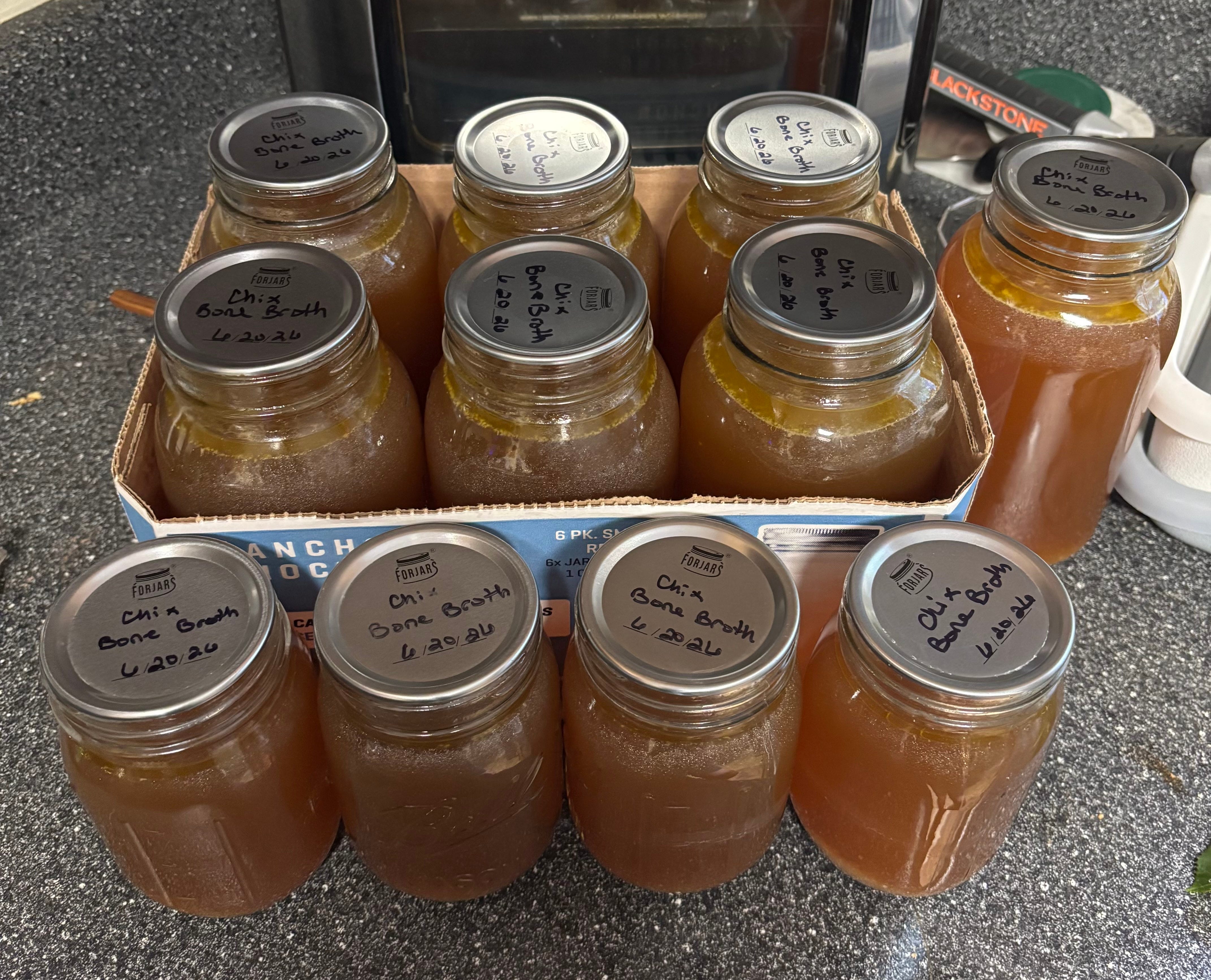
Nine quarts may not sound particularly impressive, but they represent future meals, future soups, and future convenience. They represent one less thing to purchase later.
The same is true for many of the foods I preserve throughout the year. During the height of summer, especially toward the end of July when garden production often slows, I frequently shift my focus toward pressure canning meals and meal components. Sloppy joes, stew bases, goulash base, soups, and other ready-to-use foods gradually find their way onto the pantry shelf.
None of these projects happen overnight. They happen one jar at a time. One harvest at a time. One season at a time.
Ecclesiastes 3 reminds us that there is a season for everything. Stewardship often means recognizing the season we are in and making good use of it before the next season arrives.
🌿Preparation Is Not the Same as Security
One danger in writing about preparation is that people can easily misunderstand the goal. A pantry can be helpful. A garden can be helpful. Practical skills can be helpful. But none of those things should become the source of our security.
Jesus reminds us in Matthew 6 not to be anxious about tomorrow. He points us instead toward the faithfulness of our Heavenly Father, who knows our needs before we ask.
Over the past several years, I have learned that preparation and trust are not opposites. In many ways, they complement one another. Preparation can be an act of stewardship. Trust reminds us where our ultimate security rests.
Looking around our home today, I can see evidence of lessons learned over the years. There are jars on pantry shelves, meals in the freezer, herbs drying, seeds waiting for another season, and nine quarts of bone broth cooling on the counter.
None of those things appeared overnight.
More importantly, none of them are the reason I feel secure.
They are simply reminders of God’s provision and opportunities to steward it well.
“Trust in the Lord with all thine heart; and lean not unto thine own understanding. In all thy ways acknowledge him, and he shall direct thy paths.” -Proverbs 3:5-6
🌿 I’d Love to Hear from You:
What is one thing you do differently today because of a lesson you learned in 2020?
I’d love to hear your thoughts in the comments.
“The thoughts of the diligent tend only to plenteousness…” — Proverbs 21:5 (KJV)
Wisdom over fear. Preparation over panic. Rooted in prayer.
— Constance
P.S. Next week in Prepared, Not Panicked, we’ll explore why becoming a prepared buyer has less to do with stockpiling and more to do with biblical wisdom.
🌿 Journey Through the Series
Whether you’re just beginning or returning for another read, I invite you to walk through the complete Prepared, Not Panicked series from the beginning.
Preparing with Purpose (Week 1): The Day Empty Grocery Shelves Changed My Thinking
Prepared, Not Panicked (Week 1): Seeking God’s Guidance Before the Storm
Preparing with Purpose (Week 2): Why I Shop Differently Than I Did in 2020
Preparing with Purpose (Week 3): I Didn’t Learn These Skills Overnight
Prepared, Not Panicked (Week 3): A Teachable Heart Is a Prepared Heart
Preparing with Purpose (Week 4): One of God’s Greatest Provisions Is His People
Prepared, Not Panicked (Week 4): Holding God’s Blessings with Open Hands
Prepared, Not Panicked (Week 5): Faithful Before We Understand
🌿 This article is part of a summer series, Preparing with Purpose, where I’ll be sharing practical ways our family is seeking to steward God’s provision more intentionally. Later this week, I’ll launch the companion series, Prepared, Not Panicked, which will explore the biblical principles behind these efforts.
Paid subscribers receive access to the full series, printable resources, deeper reflections, recipes, and future content as we continue walking this path together.
If this series has resonated with you, I’d love for you to continue the journey with me 🤍
🌿Did this stir something in you? Consider sharing it with a friend who may be asking similar questions.
🌿 Related Reflections
Preparing with Purpose: The Day Empty Grocery Shelves Changed My Thinking
Prepared, Not Panicked (Week 1): Seeking God’s Guidance Before the Storm
Another Virus. Another Panic. Here’s Your Counter-Move (A Collaboration with Thomas M. Hamilton & Steve | Choregeo Letters)
Faithful Health Rhythms: Small Rhythms Practiced Faithfully Become Powerful Over Time
Scripture Note: Throughout the Preparing with Purpose series, Scripture references will generally be quoted from the King James Version (KJV), one of the translations I use often in my personal study.