
A Note from Constance: This article begins a new companion series called Preparing with Purpose, where I’ll be sharing practical ways our family is seeking to steward God’s provision more intentionally. Later this week, I’ll launch Prepared, Not Panicked, a companion series exploring the biblical principles behind these efforts.
There are certain moments in life that permanently change the way we see the world. Looking back, one of those moments for me occurred in March of 2020.
My husband and I were in Cancun for a work event. By most measures, it should have been a wonderful trip. The weather was beautiful, the ocean was breathtaking, and we were surrounded by activities designed to help people relax and enjoy themselves. Yet I found it difficult to enjoy any of it. The news coming from home seemed to change by the hour, and with each update, my mind drifted further away from the beach and back toward Virginia.
I still remember Friday, March 13. I was attending an event on the beach that should have been fun, but I could not bring myself to relax. Virginia had announced that schools would be moving to virtual learning, and as a teacher, my thoughts immediately turned to my students. What would this mean for them? How long would this last? How would families manage? At the time, no one really knew.
As the weekend progressed, the uncertainty only grew. By Sunday, my husband and I found ourselves praying that the borders would remain open long enough for us to get home. Thankfully, they did. When we landed at Dulles Airport, however, it was obvious that something had changed. Customs took much longer than normal, people seemed anxious, and there was a heaviness in the air that is difficult to describe unless you experienced it.
On the drive home, we decided to stop at Wegmans for groceries. What I saw there has stayed with me ever since.
Shelf after shelf was quite empty. Items people considered basic necessities were gone. Entire sections had been picked over. Standing there, I realized something that was uncomfortable to admit.
I was not nearly as prepared as I thought I was.
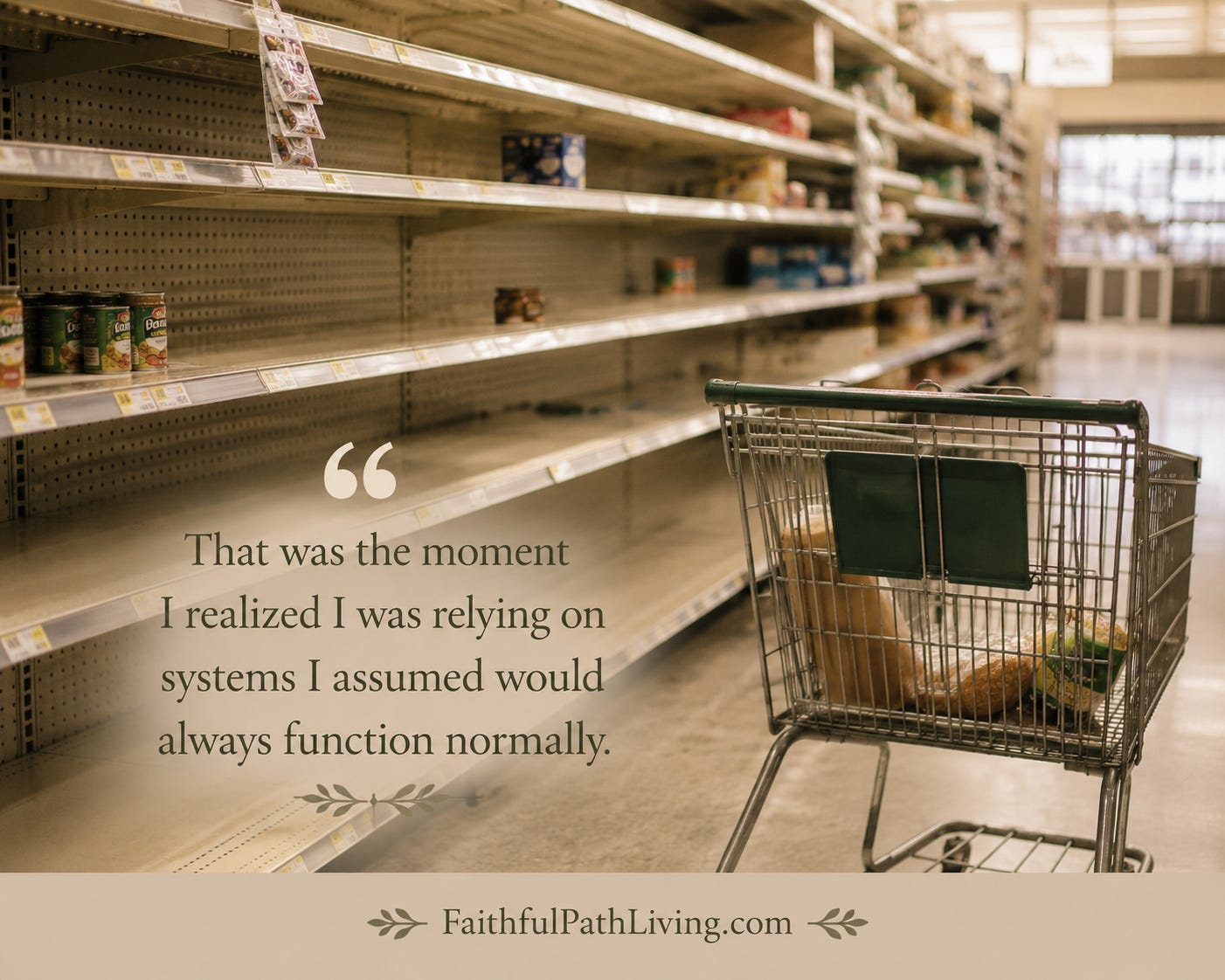
To be fair, I was not completely unprepared. We had food in the pantry and some extra supplies on hand. But that experience revealed how much confidence I had unknowingly placed in systems that I assumed would always function normally. I had assumed the shelves would always be stocked. I had assumed supply chains would continue operating as they always had. I had assumed that everyday conveniences would always be available when I needed them.
Looking back, I realize that empty grocery shelves were not what changed me most. What changed me was the realization that I had placed more trust in systems than I realized.
Recently, I had the opportunity to contribute to an article for the Narrow Path Collective about responding to uncertain times with wisdom rather than fear, Another Virus. Another Panic. Here’s Your Counter-Move. Writing that piece helped me realize there was much more I wanted to explore on the topic. That reflection eventually became the inspiration for this new series, Prepared, Not Panicked.
🌿 When My Thinking Began to Change
For the first time, I began asking questions I had never seriously considered before. What skills had previous generations possessed that many of us had lost? What could I learn? How could I become a better steward of the resources God had provided? What would happen if circumstances became more difficult?
If I am being honest, my initial response was rooted largely in self-sufficiency. I wanted to learn how to grow food. I wanted to understand food preservation. I became interested in herbs, nutrition, local food sources, and practical skills. None of those pursuits were wrong. In fact, many of them remain important parts of our lives today.
But over time, God began teaching me something deeper. The goal was never self-sufficiency. The goal was learning to recognize His sufficiency.
That shift may sound subtle, but it changed the way I think about preparation entirely. Self-sufficiency places confidence primarily in our own abilities. God’s sufficiency recognizes that everything we have ultimately comes from Him. The skills we develop, the opportunities we receive, the wisdom we gain, the people He places in our lives, and even the resources we steward all originate with Him.
🌿 Recognizing God’s Provision
As the years passed, I began seeing God’s provision in places I had previously overlooked. Sometimes His provision came through knowledge and skills learned over time. Sometimes it came through friendships with people who possessed strengths I did not have. Sometimes it came through opportunities to improve our health, strengthen our faith, or become better stewards of our resources. Most often, however, His provision came through His guidance.
One thing that has become increasingly clear to me is that preparation is not a destination. It is an ongoing process of learning, growing, and becoming a better steward of what God has entrusted to us. I certainly do not have everything figured out, and I am still learning every season.
🌿 Stewardship Looks Different for Everyone
In many ways, summer has become my favorite time to focus on these efforts. During the school year, my days are filled with lesson plans, grading, meetings, and the daily responsibilities that come with teaching. Summer provides a little more margin to evaluate our routines, learn new skills, and work on projects that often get pushed aside during the busyness of the school year.
Over the coming weeks, I plan to share some of the practical ways our family is working toward becoming better stewards of God’s provision. Some of those efforts involve growing food, sourcing healthier ingredients, learning about herbs, preserving food, strengthening community, and developing practical skills.
One lesson I have learned is that stewardship does not mean doing everything yourself. It often means recognizing the different gifts, interests, and time availability within a family and working together accordingly.Pa
For example, my husband, John, manages much of the planning, preparation, and upkeep of our garden. He genuinely enjoys that work and has developed knowledge and experience that continue to bless our family. I assist where needed, but that is not where most of my time is spent.
When harvest season arrives, however, our roles shift. I tend to take the lead on processing and preserving the food we grow. Whether that means freezing, dehydrating, water-bath canning, pressure canning, or finding ways to incorporate the harvest into our meals, those responsibilities naturally fit my interests and available time. John assists with those efforts as well, but together we have learned to work according to our strengths.
The longer I live, the more I appreciate the wisdom of approaching life this way. Not only does it make better use of our time and abilities, but it also reminds me that God never intended for one person to carry every responsibility alone. He designed families, churches, and communities with different gifts and abilities that complement one another.
🌿 Why I’m Starting This Series
Perhaps that is one of the greatest lessons God has taught me since 2020. True preparedness is not about becoming completely self-sufficient. It is about becoming more aware of His provision. Sometimes that provision comes through a garden. Sometimes it comes through a skill we take the time to learn. Sometimes it comes through a friend, a church family, or a spouse whose strengths complement our own.
And sometimes it comes through lessons we never would have chosen but desperately needed to learn.
That realization is what inspired a new summer series I will be sharing called Prepared, Not Panicked. In the weeks ahead, I will be exploring what it means to prepare wisely without living fearfully, to develop practical skills without placing our trust in them, and to seek God’s guidance before uncertainty arrives.
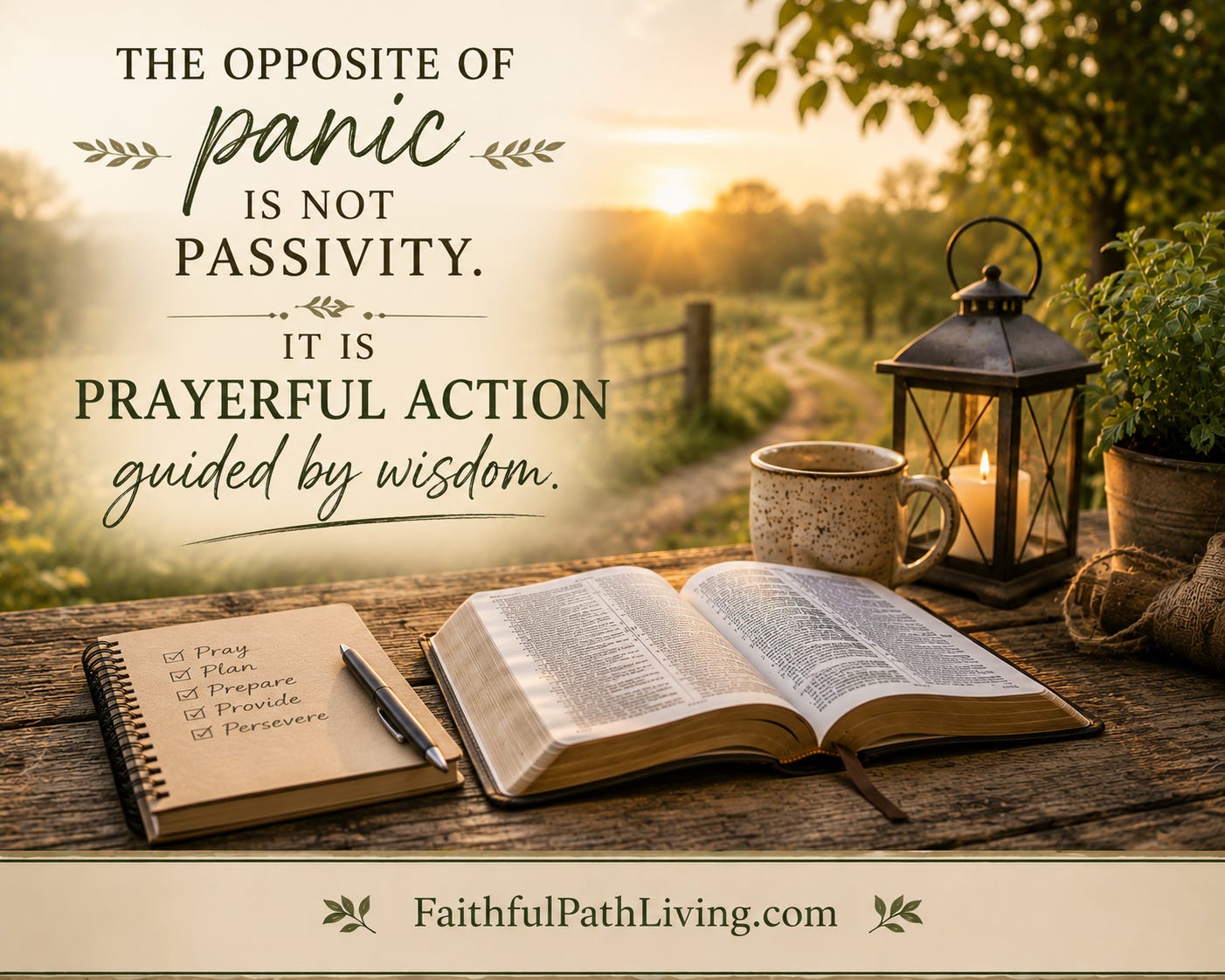
Because the opposite of panic is not passivity. It is prayerful action guided by wisdom.
“But my God shall supply all your need according to his riches in glory by Christ Jesus.” — Philippians 4:19 (KJV)
Wisdom over fear. Preparation over panic. Rooted in prayer.
— Constance
🌿 I’d Love to Hear from You:
As we begin this journey together, I’d love to hear from you:
What lessons did the events of 2020 teach you, and what areas of preparation or stewardship are you focusing on today?
Share in the comments—I may feature some of your responses in future articles.
Coming Friday:
Prepared, Not Panicked (Week 1): Seeking God’s Guidance Before the Storm
🌿 This article is part of a new summer series, Preparing with Purpose, where I’ll be sharing practical ways our family is seeking to steward God’s provision more intentionally. Later this week, I’ll launch the companion series, Prepared, Not Panicked, which will explore the biblical principles behind these efforts.
Paid subscribers receive access to the full series, printable resources, deeper reflections, recipes, and future content as we continue walking this path together.
If this series has resonated with you, I’d love for you to continue the journey with me 🤍
🌿 Journey Through the Series
Whether you’re just beginning or returning for another read, I invite you to walk through the complete Prepared, Not Panicked series from the beginning.
Preparing with Purpose (Week 1): The Day Empty Grocery Shelves Changed My Thinking
Prepared, Not Panicked (Week 1): Seeking God’s Guidance Before the Storm
Preparing with Purpose (Week 2): Why I Shop Differently Than I Did in 2020
Preparing with Purpose (Week 3): I Didn’t Learn These Skills Overnight
Prepared, Not Panicked (Week 3): A Teachable Heart Is a Prepared Heart
Preparing with Purpose (Week 4): One of God’s Greatest Provisions Is His People
Prepared, Not Panicked (Week 4): Holding God’s Blessings with Open Hands
Prepared, Not Panicked (Week 5): Faithful Before We Understand
🌿Did this stir something in you? Consider sharing it with a friend who may be asking similar questions.
🌿 Related Reflections
Faithful Health Rhythms – Week 6: Consistency Over Perfection
Grace That Transforms – Week 2: The Law Written on the Heart
Scripture Note: Throughout the Preparing with Purpose series, Scripture references will generally be quoted from the King James Version (KJV), one of the translations I use often in my personal study.
We bought a freeze dryer in the summer of 2022. We bought it with the thought that we cannot feed the world if something happens but we can help some people out. I just finished batch 411 in the freeze dryer. We store freeze dried food in the 27 gallon black bins with yellow tops. We are now filling bin 31. We have other dry food in food grade buckets (e.g. rice, rolled oats, wheat berries, salt, dry pasta, dry beans). For my wife Cindy and me, it is a journey of faith that The Lord has given us. I have learned over the years to hold all things lightly. What we are doing is not mine and I am free to share. I am a steward, not a keeper. I look forward to reading more about your journey. Daniel Kral