

What if being prepared has less to do with knowing what comes next—and more to do with trusting God enough to take the next step?
I like to know the plan.
Perhaps that is part of being a teacher. Perhaps it comes from years of working with numbers, data, schedules, and responsibilities. Give me a goal, and I naturally begin thinking about the steps needed to reach it. There is nothing inherently wrong with planning. Scripture repeatedly encourages wisdom, diligence, and preparation. Proverbs tells us to consider the ant, Joseph prepared Egypt for famine, and Jesus Himself taught us to count the cost before beginning a task.
The problem comes when I begin expecting God to give me the entire plan before I am willing to take the next step.
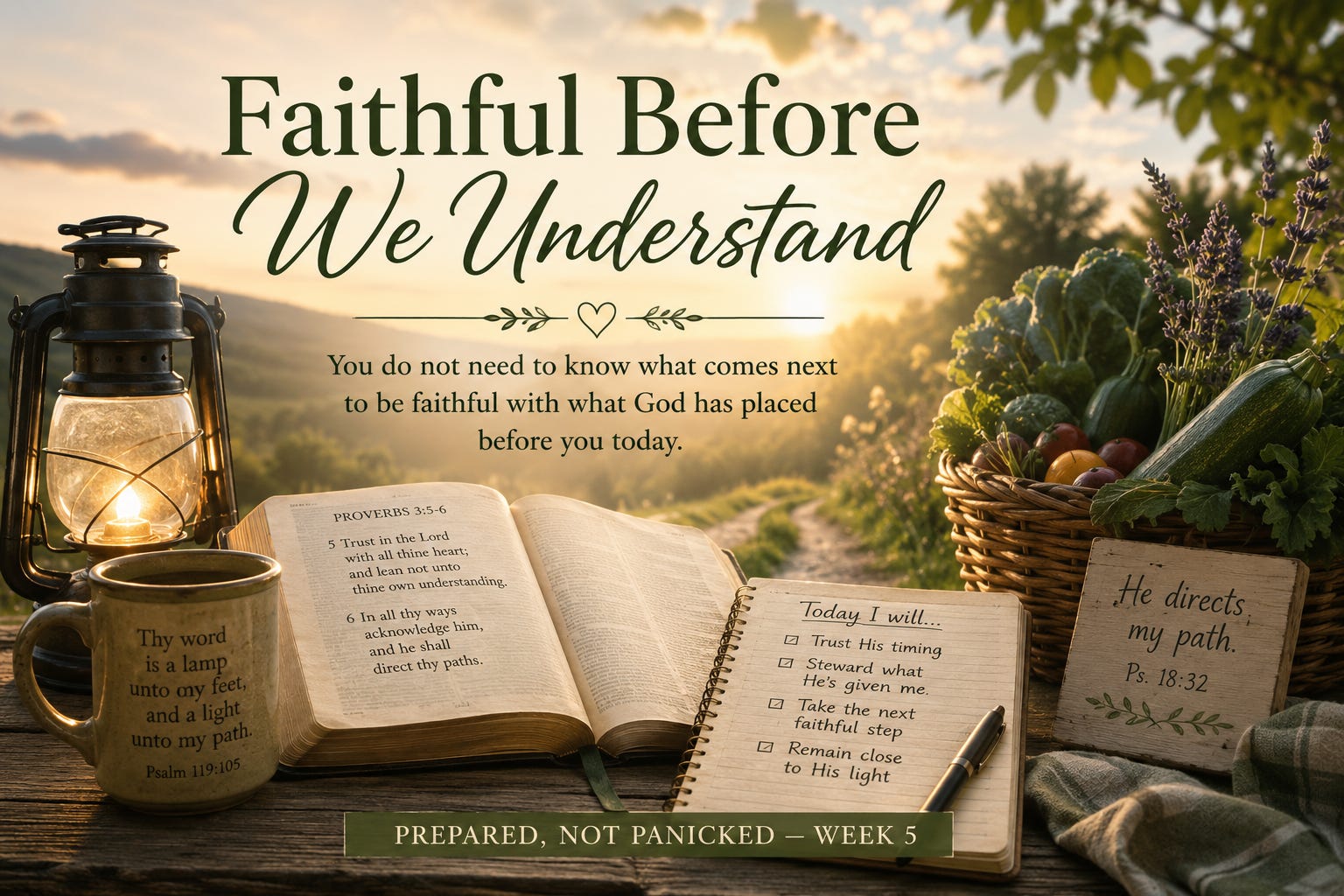
Over the years, I have discovered that He rarely leads me that way. More often, God gives me enough direction for the step in front of me. He asks me to be faithful with what I already know, obedient with what He has already placed in my hands, and willing to follow when He redirects the path. I may want a map. He often gives me a lamp.
David wrote, “Thy word is a lamp unto my feet, and a light unto my path” (Psalm 119:105). I have read that verse many times, but the imagery has become more meaningful to me as I have grown older. A lamp does not illuminate miles of road ahead. It gives enough light to see where to place your foot next.
Perhaps that is intentional.
If I could see every turn, every obstacle, every disappointment, and every unexpected opportunity that lay ahead, I might be tempted to depend upon the map rather than the One guiding me. Instead, God continually invites me to remain close to Him, listen for His direction, and trust that He can see what I cannot.
That kind of trust is at the heart of biblical preparedness.
🌿 Preparedness Cannot Give Us Certainty
One of the dangers of preparedness is that wisdom can slowly become an attempt to eliminate uncertainty. We may begin with a sincere desire to steward our resources well, learn useful skills, and care responsibly for the people God has entrusted to us. Yet somewhere along the way, we can begin believing that if we store enough, learn enough, plan enough, or anticipate enough possibilities, perhaps we will finally feel completely secure.
But no amount of preparation can give us complete control over tomorrow.
We can fill a pantry and still encounter a need we did not anticipate. We can carefully plan a garden and still face drought, pests, or disease. We can save money and encounter an expense we never expected. We can care for our bodies and still face illness. We can make thoughtful plans and watch circumstances change them in an instant.
Scripture does not tell us to ignore those possibilities, but neither does it tell us to live in fear of them. Instead, James reminds us of the proper posture toward tomorrow: “For that ye ought to say, If the Lord will, we shall live, and do this, or that” (James 4:15).
That is not a rejection of planning. It is a rejection of self-reliance.
There is a tremendous difference between saying, “I have prepared, therefore I am secure,” and saying, “I have prepared as wisely as I know how, and I still trust the Lord with everything I cannot see.”
The first places confidence in our preparation. The second places confidence in God.
Biblical preparedness does not eliminate uncertainty. It teaches us how to remain faithful within it.
That distinction has become increasingly important to me. I still believe in planning. I still believe in filling the pantry when the garden produces abundantly, learning practical skills, caring for our health, managing our finances wisely, and preparing for foreseeable needs. But I no longer believe the purpose of those things is to create a life in which I never need to trust God.
If anything, the more I learn, the more aware I become of how much remains outside my control. Perhaps that awareness is a gift.
🌿 God Often Gives the Next Step, Not the Whole Plan
Hebrews 11 contains a phrase about Abraham that I find both challenging and encouraging. Scripture tells us that when God called Abraham to leave his home and go to a place he would later receive as an inheritance, “he went out, not knowing whither he went” (Hebrews 11:8).
Not knowing where he was going.
That is not usually how I prefer to travel.
I like directions. I like knowing where I am headed, how long it should take to get there, and what I should expect when I arrive. Yet Abraham obeyed without possessing all the information I would naturally want before beginning the journey. He had direction, but he did not have the complete plan.
His confidence was not found in knowing the destination. It was found in knowing the One who called him.
That pattern appears throughout Scripture. Noah built before he ever saw rain. Joseph remained faithful through betrayal, slavery, and imprisonment without knowing that God was preparing him to preserve lives during a famine. David tended sheep and served Saul long before he sat on the throne God had promised him. Esther stepped forward without knowing whether her courage would cost her life. The disciples left their nets to follow Jesus without understanding where the journey would ultimately lead.
We sometimes imagine that biblical faith works like this: God explains the entire plan, answers all our questions, guarantees the outcome, and then we courageously agree to follow Him.
Scripture often shows something very different. God calls. He gives enough light for the next step. Then His people must decide whether they trust Him enough to walk before they understand how the story will end.
That does not mean they never questioned. It does not mean they never struggled. Scripture is remarkably honest about the fears, doubts, mistakes, and weaknesses of God’s people. Their faith was not demonstrated by perfect understanding. It was demonstrated by continuing to return to the God who understood what they could not.
Faithfulness often comes before clarity.
That truth brings me comfort because there are still areas of my own life where I do not know what God is doing. I can recognize His hand in previous seasons far more easily than I can interpret everything He is doing today. Yet the same God who faithfully guided me through the chapters I now understand is present in the chapter I am living now.
I do not need to know the ending to trust the Author.
🌿 Ask God What to Prepare for Next
This is where preparedness becomes deeply personal.
There will always be another skill we could learn, another item we could purchase, another project we could begin, or another possibility we could try to anticipate. If we are not careful, preparedness itself can become overwhelming because there is no natural end to the list.
You could learn to garden.
Then learn to preserve food.
Then learn to bake bread.
Then learn to sew.
Then learn herbalism.
Then learn first aid.
Then learn another skill and another and another.
All of those things may be useful. But usefulness alone does not mean God is asking us to pursue everything at once.
I certainly did not learn gardening, canning, cooking from scratch, milling grain, herbs, writing, and everything else our family does in one season. One thing led to another. A need arose. An opportunity opened. Someone shared knowledge. Curiosity led to learning. At times, circumstances made the next step obvious. At other times, I simply felt drawn to learn more.
I could not have told you several years ago that learning to garden would eventually lead me to preserving food, or that my own search for healing would lead me to study herbs I had once walked past without a second thought. I did not sit down and create a master list of everything I wanted to learn. Much of it unfolded one need, one question, and one season at a time. That is why I am learning to ask the Lord not only for the ability to learn, but for wisdom about what deserves my attention next.
The older I get, the more I realize I do not need to chase every possible skill. Not every opportunity is an assignment, and not every useful skill is something God is asking us to pursue right now. I need to ask the Lord for wisdom about what He wants me to learn and steward in the season I am actually living.
James 1:5 gives us a wonderfully simple promise: “If any of you lack wisdom, let him ask of God, that giveth to all men liberally.” We often turn first to books, experts, internet searches, or the opinions of other people. Those resources can certainly be useful, and God often teaches us through them. But they should never replace asking the One who already knows what lies ahead.
Perhaps instead of beginning with, “What am I afraid might happen?” we should begin with, “Lord, what are You asking me to learn in this season?”
What have You already placed before me that I need to steward better? Is there a skill I need to develop? Is there something distracting me from what You have actually called me to do? Am I preparing because You are leading me, or because fear is driving me?
Those are harder questions than simply making another list. They require prayer, patience, and a willingness to accept that God’s priorities may not always match our own. Sometimes His answer may be to learn a practical skill, it may be to strengthen a relationship. It may be to address our finances, care for our health, study His Word more deeply, or become more involved in our church community. And sometimes His answer may be to rest.
Preparedness guided by fear tells us we must do everything because we do not know what might happen. Preparedness guided by God asks us to faithfully do what He has placed before us today.
🌿 Today’s Faithfulness May Be Tomorrow’s Preparation
One of the lessons I explored in this week’s Preparing with Purpose article is how often God used ordinary seasons of my life to prepare me for things I could not yet see. At the time, accounting was simply accounting. Teaching mathematics was simply teaching. Printing Scripture cards was something I enjoyed doing for family and friends. Gardening was a practical skill we wanted to learn.
Only with time could I see how one season prepared me for another, and that has changed the way I think about ordinary responsibilities. We often want God to reveal some great future purpose while He is asking us to be faithful with something that seems small. Yet Jesus said, “He that is faithful in that which is least is faithful also in much” (Luke 16:10).
Perhaps today’s preparation looks less impressive than we expect.
It may look like learning to cook one meal from scratch.
Planting one garden bed.
Saving a little money.
Reading your Bible before beginning the day.
Calling someone who has been placed on your heart.
Learning from someone who knows more than you do.
Teaching a child.
Encouraging a friend.
Serving faithfully in a place where few people notice.
None of those things may feel significant while we are doing them. Yet we cannot always know what God will eventually do with today’s obedience.
We often want God to reveal tomorrow’s purpose while He is asking us to be faithful with today’s responsibility.
That truth changes the way I view preparation. Instead of constantly trying to predict what I will need five years from now, I can ask whether I am faithfully stewarding what God has already placed in front of me.
Tomorrow belongs to Him. Today’s obedience belongs to me.
🌿 Prepared for Every Good Work
There is another aspect of preparedness that I think we sometimes overlook.
What if God is not only preparing us to endure difficult circumstances? What if He is preparing us to serve? Paul wrote in 2 Timothy 2:21 about being “a vessel unto honour, sanctified, and meet for the master’s use, and prepared unto every good work.” I love that phrase: prepared unto every good work. That gives preparedness an entirely different purpose.
Perhaps we learn to grow food not only so our own family can eat, but so we can share a harvest with someone else.
Perhaps we preserve food not only for an uncertain future, but so we have a ready meal when a neighbor or church member needs one.
Perhaps we learn a skill so that someday we can teach it to someone else.
Perhaps we study Scripture faithfully because one day someone will need the truth God has already planted in our heart.
Perhaps God allows us to walk through a difficult season because the wisdom and compassion gained there will someday help us walk beside another person.
Preparation should not make us less dependent upon God or less connected to other people. It should make us more available for His purposes. That is the kind of preparedness I increasingly desire. Not, “I have enough, so I do not need anyone.” Not, “I know enough, so I can handle whatever happens.”
But:
“Lord, I have tried to faithfully steward what You placed in my hands. Use it however You choose.”
That is a very different posture. It is preparation with open hands.
🌿 Peace Comes From Knowing Who Leads the Path
I still like plans. I suspect I always will.
I will continue planting the garden, preserving what we harvest, learning new skills, caring for the resources God has entrusted to us, and asking Him how I can become a wiser steward. Preparation has brought many blessings into our lives, and I believe Scripture gives us good reason to plan wisely.
I am learning that preparedness was never meant to give me a complete map of the future. God has not promised me the map. He has promised to direct my path. There is a tremendous difference.
A map can tell me where I think I am going. The Lord knows where I actually need to go. A plan can prepare me for the future I imagine. God can prepare me for a purpose I cannot yet see.
Perhaps that is why the image of the lamp means so much to me. A lamp requires us to keep walking close enough to the light to see the next step. It does not satisfy our desire to know everything ahead of time. It asks us to trust. Perhaps that is exactly what God intends.
I do not know everything that lies ahead for my family. I do not know what skills we may need, what opportunities God may open, what challenges may come, or how the things I am learning today may eventually be used. But I know more about the faithfulness of the One who leads me than I did twenty years ago.
That knowledge brings a peace no pantry, plan, or practical skill could ever provide. The goal is not to know exactly what comes next. The goal is to remain close enough to the Lord that when He illuminates the next step, we are ready to take it.
We do not need certainty to be prepared. We need faithfulness to the God who already knows the way.
🌿 Reader Reflection
Are you waiting for God to show you the whole plan before obeying something He has already made clear?
Take a moment to consider whether there is a step of faithfulness already in front of you. It may not seem significant. It may not explain where the path is leading. But perhaps God is not asking you to understand the whole journey.
Perhaps He is simply asking you to take the next step with Him.
🌿 A Question to Consider
What would faithfulness look like today if you stopped demanding certainty about tomorrow?
🌿 This Week’s Challenge
Spend time with the Lord this week and ask Him:
“Lord, show me what You are asking me to faithfully steward, learn, or do in this season. Keep me from running ahead in fear or standing still while waiting for certainty. Give me wisdom for the next step and faith to follow where You lead.”
Then pay attention to what is already in front of you—and resist the urge to immediately create another list. Give the Lord room to direct your attention.
The next step may not be dramatic. It may be a conversation, a responsibility, a skill, a relationship, a habit, or an act of obedience that seems small.
Be faithful there.
You may not yet know where the path leads.
But you know the One who does.
“Trust in the Lord with all thine heart; and lean not unto thine own understanding. In all thy ways acknowledge him, and he shall direct thy paths.” — Proverbs 3:5–6 (KJV)
Wisdom over fear. Preparation over panic. Rooted in prayer.
— Constance
🌿 Prepared, Not Panicked is a reader-supported series inside Faithful Path Living where we continue exploring faith-centered rhythms for rest, stewardship, nourishment, and intentional living.
Paid subscribers receive access to the full series, printable resources, deeper reflections, recipes, and future content as we continue walking this path together.
If this series has resonated with you, I’d love for you to continue the journey with me 🤍
🌿Did this stir something in you? Consider sharing it with a friend who may be asking similar questions.
🌿 Related Reflections
Preparing with Purpose (Week 1): The Day Empty Grocery Shelves Changed My Thinking
Prepared, Not Panicked (Week 1): Seeking God’s Guidance Before the Storm
Preparing with Purpose (Week 2): Why I Shop Differently Than I Did in 2020
Preparing with Purpose (Week 3): I Didn’t Learn These Skills Overnight
Prepared, Not Panicked (Week 3): A Teachable Heart Is a Prepared Heart
Preparing with Purpose (Week 4): One of God’s Greatest Provisions Is His People
Another Virus. Another Panic. Here’s Your Counter-Move (A Collaboration with Thomas M. Hamilton & Steve | Choregeo Letters)
Scripture Note: Throughout the Prepared, Not Panicked series, Scripture references will generally be quoted from the King James Version (KJV), one of the translations I use often in my personal study.
📖 Want to go deeper? Download my FREE 7-Day Scripture Reset and begin building a more consistent time with God.
“I may want a map. He often gives me a lamp.” Constance, I love this!!
Abraham going out “not knowing whither he went” has become one of my favorite pictures of faith lately (for very personal reasons… we’re packing for a move with no destination yet).
I appreciate you sharing how, as God was teaching you step by step, it led to more of what you really needed to know.
My healing journey from bipolar disorder was a lot like that. I learned a lot of things along the way that eventually came together into a complete strategy for healing (because God is so good and faithful to bring us through it).