

Six weeks ago, we began this series with a simple question:
How do we prepare without living in fear?
When I first sat down to outline this series, I thought I knew exactly what I was going to write.
The plan seemed straightforward enough. Over the course of several weeks, I wanted to explore what it meant to prepare wisely without giving in to fear. I envisioned writing about practical stewardship—planting gardens, preserving food, learning useful skills, strengthening community, and caring well for the resources God has entrusted to us. In a world that often swings between panic and complacency, I wanted to encourage a more biblical response.
At least, that’s what I thought I was writing.
As the weeks passed, however, something unexpected happened.
Every Thursday, I would sit down at my computer with an outline in front of me. I knew the practical topic I intended to cover, yet by the time I reached the end of each article, I found myself writing about something entirely different. Whether I began with grocery stores, gardens, preserving food, or learning new skills, the Lord kept leading me back to the same place.
The heart.
It became increasingly difficult to separate practical stewardship from spiritual formation because Scripture never separates them. God has always been far more interested in shaping His people than simply improving their circumstances. The practical lessons mattered, but they were never the destination. They were simply the tools He used to teach something deeper.
Looking back, I realize that God wasn’t just guiding the direction of the series. He was quietly changing the way I think.
🌿 More Than Practical Preparation
When we first talked about empty grocery store shelves, the conversation wasn’t really about groceries. It was about recognizing how quickly we can place our confidence in things that feel stable, only to discover how fragile they really are. That experience became an invitation to examine a deeper question: Where does my sense of security actually come from?
As the series continued, the garden naturally became part of the conversation. That wasn’t surprising, considering how much time my husband and I spend there during the summer months. Gardens have a way of slowing us down. They refuse to cooperate with our schedules or our expectations. You cannot rush a tomato into ripening or convince a cucumber to grow because you’re impatient. You prepare the soil. You plant the seed. You water faithfully. Then you wait.
That waiting has become one of God’s greatest teachers in my own life.
Paul’s words in 1 Corinthians 3:6 have taken on fresh meaning since we began gardening: “I have planted, Apollos watered; but God gave the increase.” I’ve read that verse many times over the years, always understanding its spiritual application. Yet standing in the garden has allowed me to experience it in a new way. I can pull weeds, add compost, and carefully tend each plant, but I cannot make a single seed grow. Every harvest is ultimately a reminder that I am a steward, not the Creator.
Perhaps that’s why Jesus so often pointed people toward the natural world. He spoke of seeds, vineyards, fig trees, sparrows, lilies, and harvest fields because creation continually reveals something about its Creator. It teaches us both our responsibility and our limitations. We are called to work faithfully, but we are never called to carry responsibilities that belong to God alone.
That lesson continued as we explored practical skills. Learning to preserve food, cook from scratch, grow herbs, or repair something around the house certainly has practical value. Previous generations understood many of these things simply because they were part of everyday life. Recovering some of that knowledge can make us wiser stewards of what God has given us.
But somewhere along the way, I realized those skills were shaping more than my hands.
They were shaping my heart.
Every loaf of freshly milled sourdough reminds me that good things often take time. Every jar lined neatly on the pantry shelf reminds me of God’s provision during seasons of abundance. Every basket of herbs hanging to dry reminds me that the Lord has filled His creation with gifts I overlooked for years. The practical work itself has become an act of gratitude.
The more I slowed down to learn these skills, the more I found myself slowing down to notice God.
That may be one of the greatest surprises of this entire journey.
When I first became interested in herbs, I thought I was simply trying to improve my health. After years of autoimmune disease, medications, fatigue, and wondering if I would ever feel well again, I began paying closer attention to the plants God had created. I certainly wasn’t thinking about writing articles or creating journals. I was simply looking for another way to care for the body God had given me.
Now I can see that even those difficult years were part of His preparation.
Had I never struggled with my health, I doubt I would have planted many of the herbs now growing in our garden. I probably would have walked right past self-heal without noticing it, never realizing that what I assumed was just another pretty wildflower had been quietly growing there all along. I might never have experienced the joy of harvesting chamomile by hand or the simple peace that comes from blending a cup of tea from herbs we grew ourselves.
God was teaching me through His creation long before I recognized the lesson. Perhaps that’s been the story of this entire series.
I thought we were talking about preparedness. God was teaching me trust.
🌿 The Gift of Rest
As I reflected on all of this, my husband and I took a short trip to the mountains of West Virginia. We stayed in one of the state park cabins, surrounded by towering trees and the quiet beauty of God’s creation. One morning, before the day began, I carried my Bible and a cup of coffee out onto the porch. There was no agenda, no schedule to keep, and no list of chores waiting to be crossed off. For a little while, I simply sat in the stillness, listening to the birds and watching the morning light slowly spill across the mountains.
It struck me how difficult it can be to truly rest.
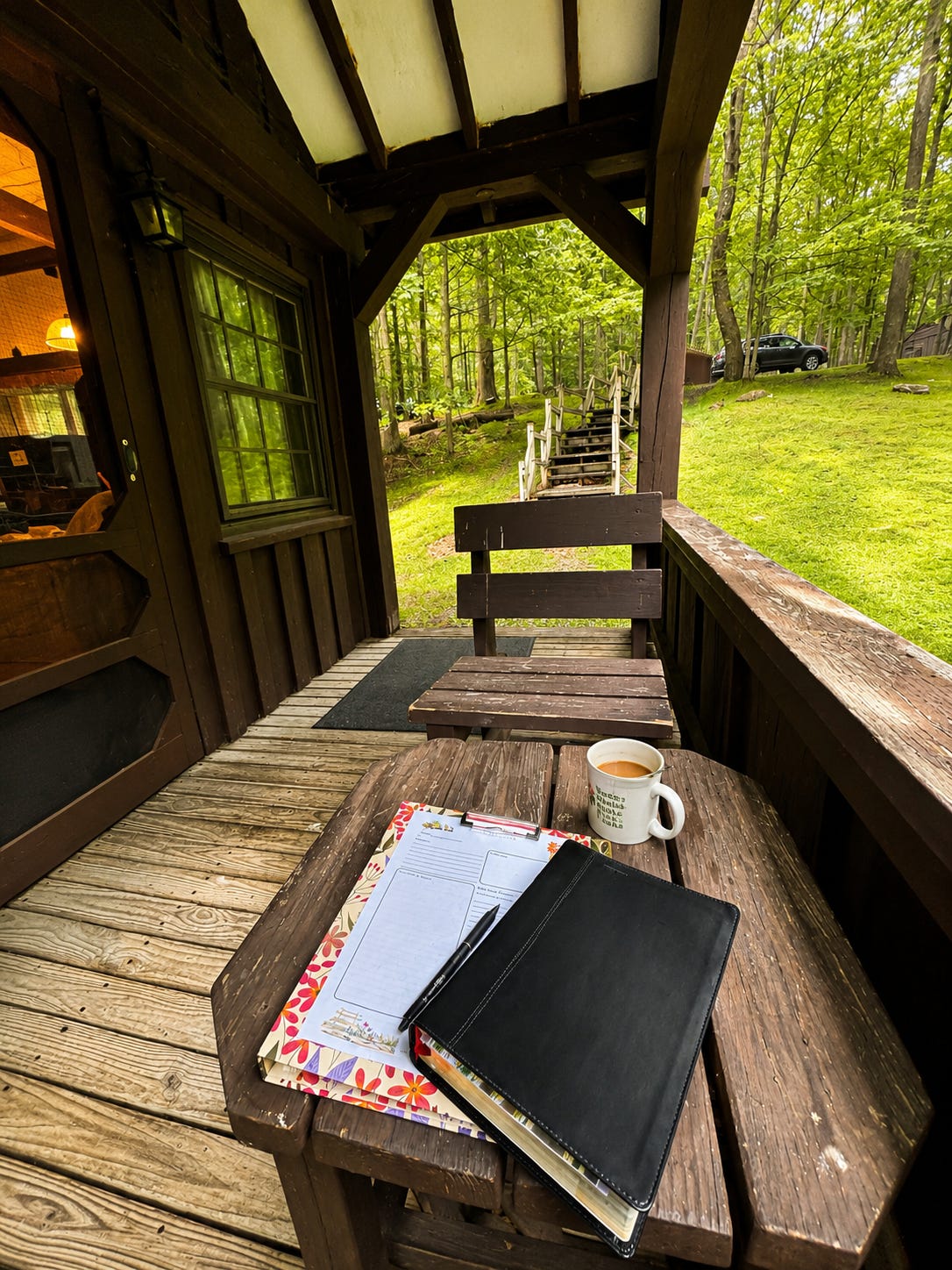
Even when our bodies stop moving, our minds often continue racing. We replay conversations, plan tomorrow’s tasks, and think about everything that still needs our attention. I have discovered that it is entirely possible to sit in a peaceful place while carrying a restless heart.
As I opened my Bible that morning, I was reminded of Jesus’ words in Matthew 11:28–30:
“Come unto me, all ye that labour and are heavy laden, and I will give you rest. Take my yoke upon you, and learn of me; for I am meek and lowly in heart: and ye shall find rest unto your souls. For my yoke is easy, and my burden is light.”
I realized that the invitation Jesus offers is far deeper than physical rest. He offers rest for anxious hearts. Rest for people who feel responsible for carrying tomorrow before tomorrow arrives. Rest for those of us who sometimes confuse faithful stewardship with believing everything depends on us.
The next day, we returned home.
The garden had not stood still while we were away.
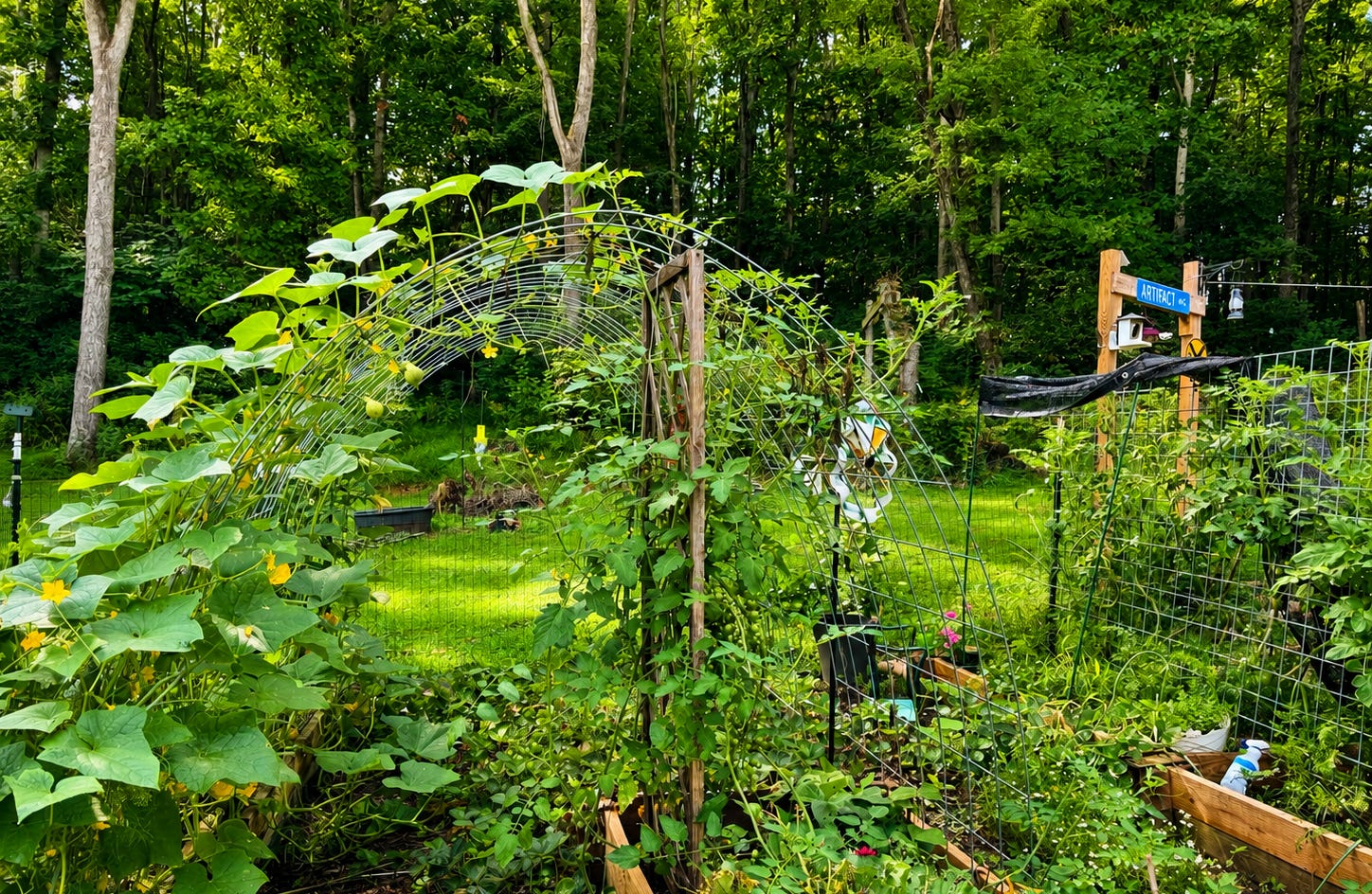
The tomatoes needed trimming. The cucumbers were ready to harvest. The squash vines had wandered farther than expected, and the chamomile was waiting patiently to be gathered. The work was still there—perhaps even more than before.
Yet something was different.
The garden no longer felt like another list demanding my attention. Instead, it felt like an invitation to join God in the work He had already been doing. While I rested, He had continued sending sunshine and rain. Seeds continued growing beneath the soil without my supervision. Flowers continued blooming because the Creator had faithfully sustained them.
The work had never depended entirely on me.
That simple realization brought an unexpected peace.
For much of my life, I believed preparedness meant having enough. Enough knowledge. Enough food in the pantry. Enough savings. Enough plans. Enough answers to whatever the future might hold.
There is certainly wisdom in planning. Proverbs repeatedly commends diligence and foresight. Joseph’s preparation during seven years of abundance preserved countless lives during seven years of famine. Scripture never presents wisdom and trust as opposing ideas.
But somewhere along the way, I realized I had quietly allowed preparation to become something God never intended it to be.
I had begun measuring peace by how prepared I felt.
The problem is that there will always be one more skill to learn, one more project to finish, one more item to purchase, one more uncertainty to consider. If our peace depends on finally feeling prepared enough, we will spend our lives chasing a finish line that continually moves farther away.
Biblical preparedness invites us to something entirely different.
It calls us to steward faithfully what God has placed in our hands today while entrusting tomorrow to the One who already holds it.
That doesn’t remove uncertainty.
It transforms the way we live within it.
🌿 A Peace That Doesn’t Depend on Circumstances
One passage has lingered in my heart throughout this series more than any other. Habakkuk paints a picture that would have been devastating to his readers:
“Although the fig tree shall not blossom, neither shall fruit be in the vines; the labour of the olive shall fail, and the fields shall yield no meat; the flock shall be cut off from the fold, and there shall be no herd in the stalls…” (Habakkuk 3:17, KJV)
Nearly every source of provision is gone. The harvest has failed. The fields are empty. The future is uncertain. Yet Habakkuk continues with one of the most remarkable declarations of faith in all of Scripture:
“Yet I will rejoice in the Lord, I will joy in the God of my salvation. The Lord God is my strength…” (Habakkuk 3:18–19, KJV)
Notice what Habakkuk does not say. He does not rejoice because everything turned out well or that his preparations guaranteed security. He rejoices because the Lord Himself had become his confidence.
I believe that is the destination God has been leading us toward throughout this entire series.
Biblical preparedness is not ultimately about preparing for uncertain days. It is about becoming the kind of person who remains faithful no matter what kind of days come.
That kind of faith cannot be stored on a shelf, preserved in a jar, purchased or stockpiled. It is cultivated one day at a time as we learn to walk with Christ.
As I think back over these past six weeks, I realize that every topic pointed toward the same truth. The garden reminded us that growth belongs to God. Practical skills taught us the value of faithful stewardship. Community reminded us that God often provides through His people. Every season—even the difficult ones—revealed His patient work in our lives. And when we could not see the whole path ahead, His Word remained a lamp for the next faithful step.
Each lesson quietly asked the same question: Will you trust Me?
Not when everything makes sense, when every prayer is answered the way you hoped, or when you feel fully prepared. Today. Here. In this ordinary moment.
Perhaps that is why Jesus spent so much of His ministry calling people to daily faithfulness. He did not tell His followers to worry about tomorrow. Instead, He reminded them that their heavenly Father already knew what they needed. He pointed to the birds of the air and the lilies of the field—not to encourage passivity, but to reveal the faithful care of the God who sustains His creation.
The more I learn, the more I find myself returning to a simple prayer:
“Lord, help me faithfully steward what You’ve placed before me today, and help me trust You with everything that belongs to tomorrow.”
I suspect that prayer will take me much farther than trying to answer every “what if” my mind can imagine.
As we close this series, my prayer for each of us is not simply that we become more prepared. I pray that we become more peaceful—not because life has become more predictable, but because our confidence has become more firmly anchored in Christ.
May we continue choosing wisdom over fear.
Preparation over panic.
Stewardship over anxiety.
Faithfulness over certainty.
And may our lives bear witness to the quiet confidence that comes from walking with the One who has already gone before us.
Next week, we’ll begin a new journey together as we explore another beautiful expression of God’s faithful provision: the herbs He has woven throughout His creation. What began as a personal desire to better understand the plants growing in my own garden has become another reminder that our Creator has filled the world with gifts waiting to be discovered. I’m looking forward to sharing that journey with you.
Until then, let us continue preparing our hearts far more diligently than our shelves.
Because when our hearts are prepared, we can live with a peace the world cannot explain.
🌿 Read the Complete Prepared, Not Panicked Series
Over the past six weeks, we’ve explored what it means to prepare wisely without living in fear. Each article builds on the one before it, revealing that biblical preparedness is ultimately about faithful stewardship and trusting God with the future.
Preparing with Purpose (Week 1): The Day Empty Grocery Shelves Changed My Thinking
Prepared, Not Panicked (Week 1): Seeking God’s Guidance Before the Storm
Preparing with Purpose (Week 2): Why I Shop Differently Than I Did in 2020
Preparing with Purpose (Week 3): I Didn’t Learn These Skills Overnight
Prepared, Not Panicked (Week 3): A Teachable Heart Is a Prepared Heart
Preparing with Purpose (Week 4): One of God’s Greatest Provisions Is His People
Prepared, Not Panicked (Week 4): Holding God’s Blessings with Open Hands
Prepared, Not Panicked (Week 5): Faithful Before We Understand
Reflection
As you think back over this series, which lesson has stayed with you the longest?
Has the Lord changed the way you think about stewardship, preparation, or trusting Him with the future?
I’d genuinely love to hear what He’s been teaching you. Some of my favorite moments as a writer have come from reading your stories and seeing the different ways God has been at work in your lives.
This Week’s Challenge
Spend a few quiet moments with the Lord this week and ask Him:
“Where have I been placing my confidence? In my preparation… or in You?”
Then thank Him for His faithful provision in every season—past, present, and future—and ask Him to continue shaping your heart into one that rests confidently in His care.
“Peace I leave with you, my peace I give unto you: not as the world giveth, give I unto you. Let not your heart be troubled, neither let it be afraid.”
— John 14:27 (KJV)
🌿 Series Complete
Prepared, Not Panicked explored how Christians can respond to uncertain times with wisdom instead of fear, stewardship instead of anxiety, and faith instead of panic.
Continue your journey: Next week we begin a new Faithful Path Living series exploring God’s provision through herbs, biblical stewardship, and the wisdom found in His creation.
🌿 Prepared, Not Panicked is a reader-supported series inside Faithful Path Living where we continue exploring faith-centered rhythms for rest, stewardship, nourishment, and intentional living.
Paid subscribers receive access to the full series, printable resources, deeper reflections, recipes, and future content as we continue walking this path together.
If this series has resonated with you, I’d love for you to continue the journey with me 🤍
🌿Did this stir something in you? Consider sharing it with a friend who may be asking similar questions.
🌿 Related Reflections
Another Virus. Another Panic. Here’s Your Counter-Move (A Collaboration with Thomas M. Hamilton & Steve | Choregeo Letters)
Scripture Note: Throughout the Prepared, Not Panicked series, Scripture references will generally be quoted from the King James Version (KJV), one of the translations I use often in my personal study.
📖 Want to go deeper? Download my FREE 7-Day Scripture Reset and begin building a more consistent time with God.