

For years, I thought feeling inflamed, exhausted, uncomfortable after eating, and dependent on medications was simply part of being busy and getting older.
More inflammation.
More digestive issues.
More medications.
More foods I could no longer tolerate.
I kept trying to manage the symptoms without ever asking why my body was struggling so much in the first place. For a long time, I thought feeling uncomfortable after eating was simply normal.
I think many people have become so accustomed to feeling bloated, inflamed, exhausted, or uncomfortable after eating that they no longer recognize those things as signals worth paying attention to. Like many people, I learned to work around the symptoms instead of asking deeper questions about why my body might be struggling in the first place.
When life is busy, it often feels easier to simply keep functioning.
Teaching full time doesn’t leave much room for slowing down and carefully evaluating how different foods affect you. Lunches are rushed, stress is high, and by the end of the day convenience can feel far more appealing than intentionality. For years, I simply adapted.
But over time, I began noticing something important:
My body was responding differently depending on how I nourished it.
Not dramatically overnight.
Not through extreme dieting.
Not through perfection.
But through patterns.
Maybe the math teacher in me should have recognized that sooner.
I’ve spent years teaching students to look for patterns, identify relationships, and pay attention to what consistently repeats. Slowly, I began realizing the body works much the same way.
I certainly do not approach any of this perfectly, and this journey has unfolded slowly over many years. It has looked different in different seasons depending on budget, energy, and what was realistically possible at the time.
🌿 Learning to Pay Attention
One of the biggest shifts in my health journey has been learning to stop immediately masking symptoms without asking why they were happening in the first place.
For years, whenever a new issue appeared, my first instinct was simply to look for the next solution that would help me manage it. If I struggled with allergies, digestive issues, inflammation, reflux, exhaustion, or other symptoms, the focus was usually on finding the right medication to reduce the discomfort quickly enough for me to keep functioning.
And my doctors were generally happy to help me do exactly that.
Looking back now, I realize that many of my doctor appointments centered almost entirely around managing prescriptions. Adjusting medications. Adding medications. Discussing side effects. Trying to balance one issue against another.
At the time, I didn’t really question it because I assumed that was simply what health care was supposed to look like. I depended heavily on doctors to guide my health, but I had spent very little time actually learning how to support my body well in the first place.
At some point I realized I had become incredibly knowledgeable about managing symptoms… but knew very little about how to actually build health.
That realization was difficult for me.
Not because I believe medicine is bad or unnecessary. There are absolutely situations where medications are needed and deeply beneficial. I am grateful for medical care and still utilize it when necessary.
But eventually I began realizing there is a difference between managing symptoms and building health.
The more I paid attention, the more I realized my body had been communicating with me for years.
Inflammation was communication.
Digestive issues were communication.
Exhaustion was communication.
Poor sleep was communication.
And instead of only asking how to silence those signals, I slowly began asking a different question:
What is my body struggling to tell me?
That question changed the direction of my health journey far more than I expected.
🌿 A Simpler Way of Eating
As I shared in earlier weeks, one of the books that challenged me to think differently about food was The Biblio Diet. While I do not approach any of this with perfection or legalism, the book encouraged me to think more intentionally about whole foods, inflammation, and the ways modern eating habits may be affecting the body.
Long before I made the switch to organic foods, I had already spent more than a decade trying to move toward healthier eating habits. I cooked from scratch, avoided many highly processed foods, and became very intentional about reducing foods commonly associated with inflammation. Gluten, soy, and dairy were some of the main things I removed for long periods of time, along with several other foods that seemed to trigger symptoms.
Those changes did help significantly - for a while.
Eventually, I reached a point where my body still seemed to be struggling despite all the effort I was putting into “eating clean.” My health was deteriorating more severely, and I remember feeling deeply frustrated because it seemed like I was doing everything I had been told should help.
I remember reaching a point where I realized I was structuring large parts of my life around managing symptoms. Medications were organized carefully. Foods were constantly being avoided. Energy was inconsistent. And despite all the effort, I still didn’t feel well.
That season forced me to start asking deeper questions.
One of the biggest things I began learning about was the impact pesticides and chemical exposure may be having on the body over time. The more I researched, the more I started understanding why so many people emphasized organic foods so strongly. It wasn’t simply about trends or labels. It was about reducing the constant burden of chemicals and pesticides the body is continually trying to process.
So little by little, I started transitioning toward organic ingredients when possible. Surprisingly, one of the first things I noticed was not only how differently my body responded, but how much better the food actually tasted.
Over time, I found myself moving more and more toward simpler ingredients and less processed foods overall. I started paying closer attention to labels, additives, oils, sugars, and highly processed convenience foods. I focused more intentionally on foods that felt nourishing instead of simply quick.
And little by little, I noticed changes.
Somewhere along the way, I realized I had spent years thinking mostly in terms of restriction and avoidance.
Avoiding foods.
Avoiding symptoms.
Avoiding reactions.
Slowly, my perspective began changing, and I started thinking less about restriction and more about replenishment.
Supporting the body well.
Nourishing instead of merely managing.
Giving my body the things it needed to function, restore, and heal more faithfully over time.
The IBS medication I once depended on was no longer necessary. I was able to stop taking the allergy medications I had relied on for years. The acid reflux medications I once thought I would always need became far less necessary as well.
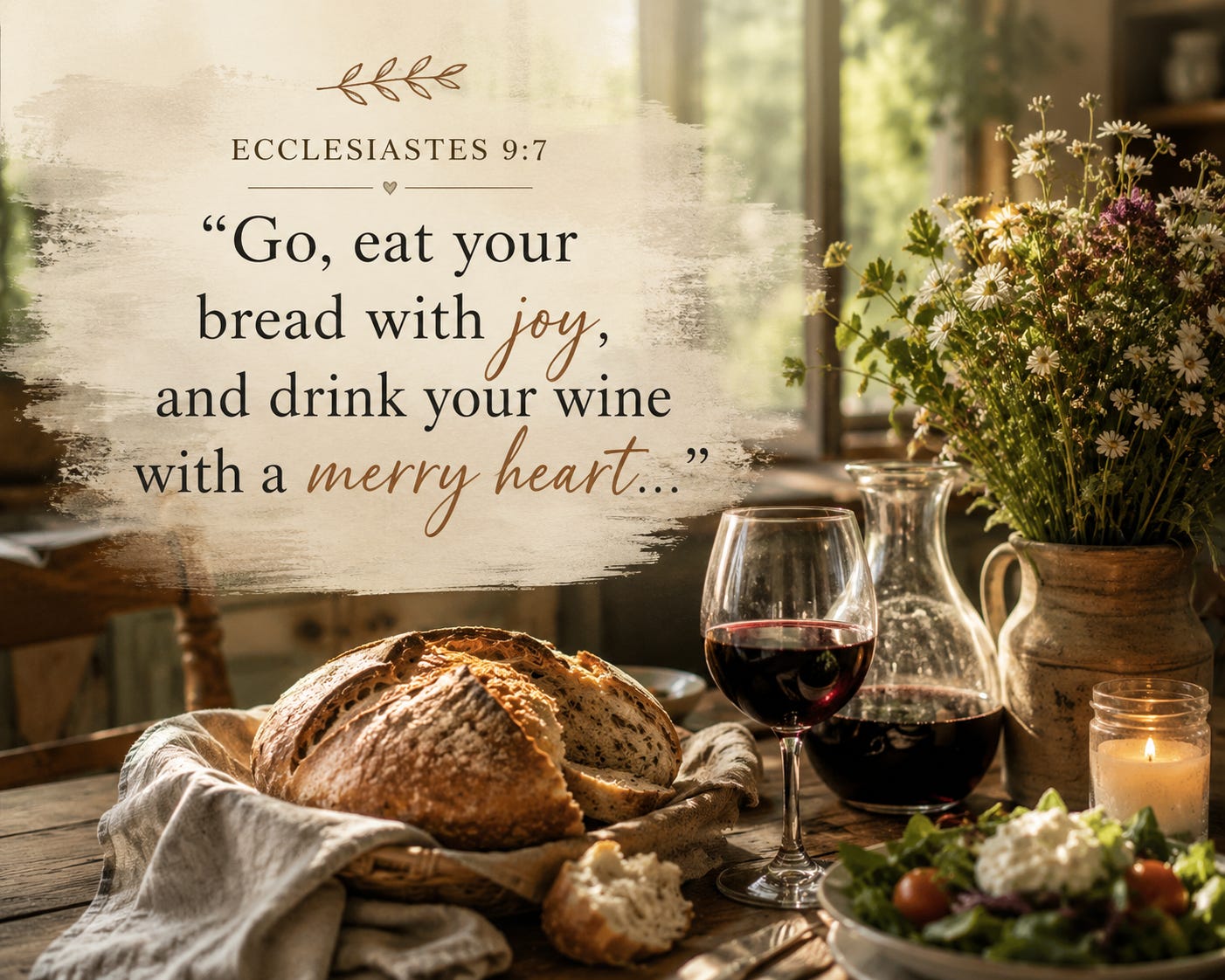
One of the most surprising changes for me was realizing I could once again enjoy things like hard cheeses and freshly milled sourdough bread my husband makes.
That may sound small to some people, but when your body has struggled with inflammation and digestive discomfort for a long time, those small changes feel deeply significant.
🌿 Food and Inflammation
I think many people are walking through life more inflamed, exhausted, and depleted than they realize. Those feelings become so common, we begin assuming they are simply part of getting older or being busy.
But inflammation affects far more than temporary discomfort.
It can affect sleep.
Energy.
Focus.
Digestion.
Hormones.
Stress levels.
And overall well-being.
The more I learned about how the body responds to chronic stress, processed foods, lack of rest, and overstimulation, the more connected everything began to seem. And the more I studied Scripture alongside this journey, the more I realized how often God speaks about provision, nourishment, and caring for what He has entrusted to us.
In 1 Corinthians 6:19-20, we are reminded:
“Do you not know that your body is a temple of the Holy Spirit within you, whom you have from God? You are not your own, for you were bought with a price. So glorify God in your body.”
For a long time, I viewed health almost entirely through the lens of symptom management. Slowly, I began seeing stewardship differently. Caring for the body God created was not about obsession, fear, or perfection. It was about honoring what He entrusted to me.
I also found myself reflecting often on the way Scripture consistently points back to simple provision.
Genesis 1:29 says:
“Behold, I have given you every plant yielding seed that is on the face of all the earth, and every tree with seed in its fruit. You shall have them for food.”
And Psalm 104:14 reminds us:
“You cause the grass to grow for the livestock and plants for man to cultivate, that he may bring forth food from the earth.”
The older I get, the more I appreciate the wisdom and simplicity in that.
Real ingredients.
Food prepared more intentionally.
Nourishment instead of constant convenience.
This was never just about food. It was about stewardship. About creating rhythms that support the body instead of constantly working against it.
🌿 The Emotional Side of Food
One thing I don’t think we talk about enough is how emotional our relationship with food can become.
Food is connected to comfort, celebration, exhaustion, stress, family traditions, convenience, memories, and routines. That means changing the way we eat often affects far more than our physical health.
Over time, I began realizing that preparing food at home was affecting more than just my body. It was changing the atmosphere of our home as well. There is something deeply meaningful about meals prepared with intention and care instead of constantly relying on rushed drive-thru food or whatever is most convenient in the moment. Cooking from scratch creates space for creativity, slower rhythms, conversation, and family connection if we allow it.
Some of my favorite moments now are the simplest ones: fresh bread cooling on the counter, meals prepared together, herbs from the garden, and sitting around the table knowing the food in front of us was prepared with love and nourishment in mind. It’s deeply fulfilling to know your family is being nourished and replenished by what you are providing.
That doesn’t mean the transition is always easy.
Sometimes family members do not immediately understand why you are changing certain ingredients or becoming more intentional about food choices. It can feel easier to simply continue doing what everyone is accustomed to.
But I’ve learned that gentleness matters.
Not fear.
Not pressure.
Not legalism.
Just thoughtful guidance toward what is better. Toward what nourishes well. Toward what supports the body more faithfully over time.
I’ve also had to learn that caring for my health does not mean approaching food with fear.
It means learning and developing wisdom.
Learning what helps my body thrive.
Learning what leaves me depleted.
Learning that nourishment and stewardship matter.
And also learning that perfection is not the goal.
I still believe meals should be joyful. I still believe there is room for grace, celebration, and togetherness. But I also no longer ignore the reality that what we consistently consume affects the body in very real ways.
🌿 Returning to Real Food Without Fear
The older I get, the more I find myself returning to simpler things.
Fresh ingredients.
Homemade meals.
Freshly milled bread.
Herbal tea.
Gardens.
Cooking from scratch.
Slower rhythms.
In many ways, this journey has felt less like discovering something entirely new and more like relearning rhythms we were never meant to lose.
For years, like many busy families, convenience often shaped our choices more than intentionality. After full days of teaching, grading, overstimulation, and decision fatigue, convenience often felt easier than intentionality. And honestly, sometimes they are.
But over time, I began noticing how differently our home felt when meals were prepared more intentionally. There is something grounding about slowing down long enough to prepare real food, gather around the table, and nourish the people you love well.
Modern convenience has given us faster food, but I’m not convinced it has given us better nourishment.
And I don’t just mean nutritionally. I mean emotionally. Spiritually. Relationally.
Some of my favorite moments now are the simplest ones—fresh bread cooling on the counter, herbs from the garden, everyone gathering in the kitchen while dinner finishes cooking, and the quiet satisfaction of knowing the meal in front of us was prepared with care.
That kind of nourishment feels different.
Not trendy.
Not complicated.
Just real.
But one of the most important things I’ve learned through this journey is that stewardship and fear are not meant to lead us in the same way.
As I began learning more about food quality, pesticides, inflammation, and the ways modern living can burden the body, I had to be careful not to let fear become the driving force behind my choices.
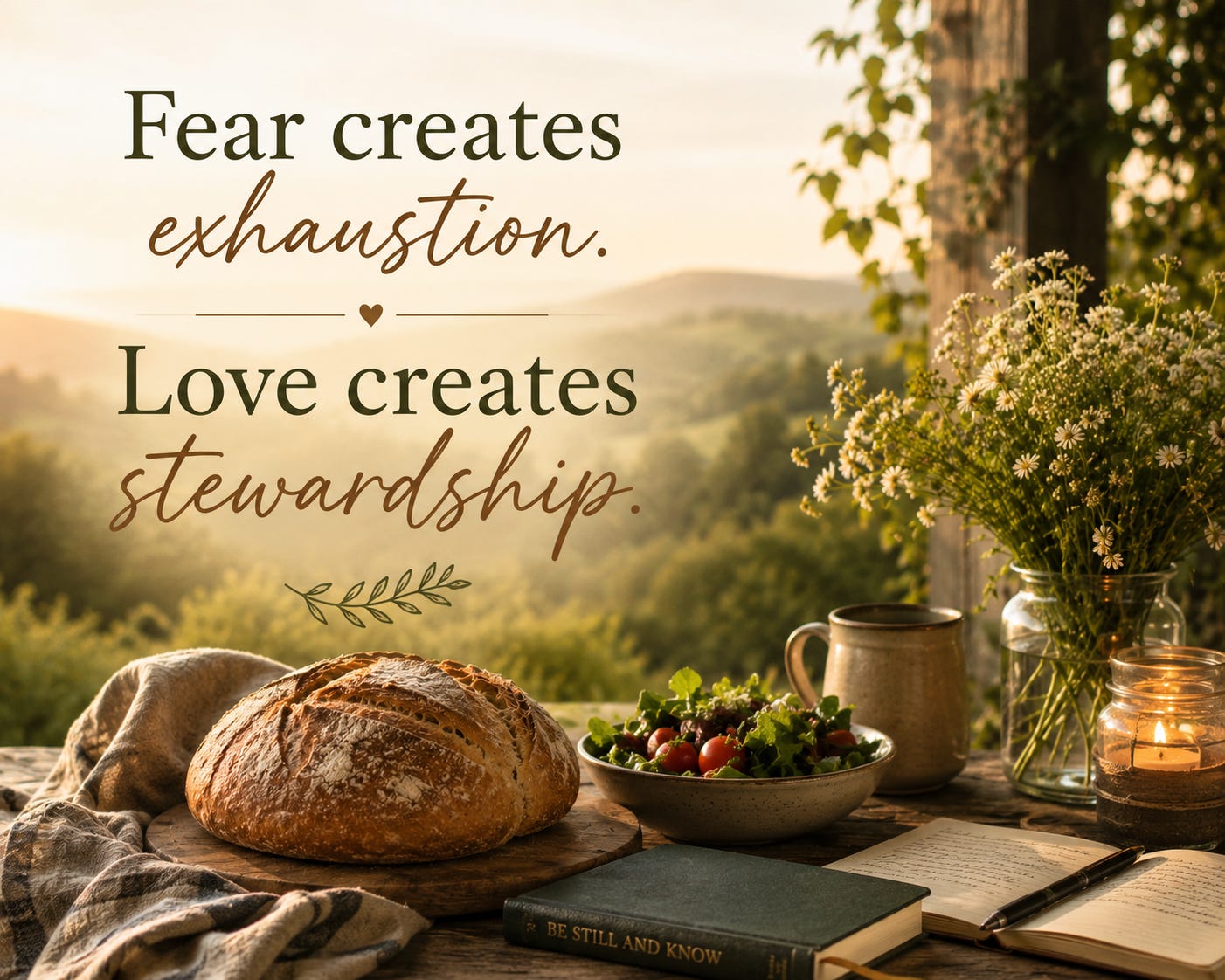
Fear creates exhaustion. Love creates stewardship.
I don’t want anxiety to control every ingredient.
I don’t want health to become an idol.
I don’t want fear to rob the joy from gathering around the table with people I love.
Scripture reminds us in 2 Timothy 1:7:
“For God gave us a spirit not of fear but of power and love and self-control.”
And in 1 John 4:18:
“There is no fear in love, but perfect love casts out fear.”
The older I get, the more I realize that love is a far better motivator than fear ever will be.
Love for the body God entrusted to me.
Love for my family.
Love expressed through preparing nourishing meals, slowing down enough to care well for others, and creating rhythms that support health instead of constantly working against it.
There is a peace that comes from knowing you are caring well for the people and body God entrusted to you, even imperfectly.
That kind of stewardship feels very different than obsession. It is quieter. More peaceful and sustainable. There is a quiet middle ground I think many of us are searching for.
A place of intentionality without fear.
Awareness without obsession.
Stewardship without striving.
That is the place I’m still learning to walk.
🌿 This Week’s Gentle Practice
This week, pay attention to how your body responds after eating.
Not with judgment.
Not with guilt.
Just with awareness.
Notice what leaves you feeling nourished, steady, and supported… and what consistently leaves you feeling depleted.
Sometimes wisdom begins simply by paying attention.
🌿 Reflection
Have you been nourishing your body… or simply filling it?
There is a difference.
I’m beginning to believe that many of the healthiest changes happen quietly.
Through paying attention and slowing down. Through learning what truly nourishes us instead of simply consuming whatever is convenient.
Perhaps part of stewardship is recognizing that the body often responds best not to extremes, but to consistent care practiced faithfully over time.
That, too, feels like part of walking faithfully.
🌿 Faithful Health Rhythms is a reader-supported series inside The Faithful Path where we continue exploring faith-centered rhythms for rest, stewardship, nourishment, and intentional living.
Paid subscribers receive access to the full series, printable resources, deeper reflections, recipes, and future wellness content as we continue walking this path together.
If this series has resonated with you, I’d love for you to continue the journey with me 🤍
🌿Did this stir something in you? Consider sharing it with a friend who may be asking similar questions.
🌿 Related Reflections
Learning to Slow Down Enough to Rest, Restore, and Hear God More Clearly
Modern Convenience, Real Nourishment, and the Rhythms We Were Never Meant to Lose
Scripture quotations are from The Holy Bible, English Standard Version® (ESV®), copyright © 2001 by Crossway, a publishing ministry of Good News Publishers. Used by permission. All rights reserved.